
From recycled plastic to a feasible solution
The May issue of Link Magazine features the ReCYCLE project, which highlights our vision for the circular use of plastics. Together with supply chain partners, we demonstrate how recycled plastics can be used in practice to create high-quality products without compromising on quality or functionality. The article makes it clear that an integrated approach—from material selection and design to validation and production—is essential for achieving feasible solutions, reducing CO2 emissions, and creating future-proof products.
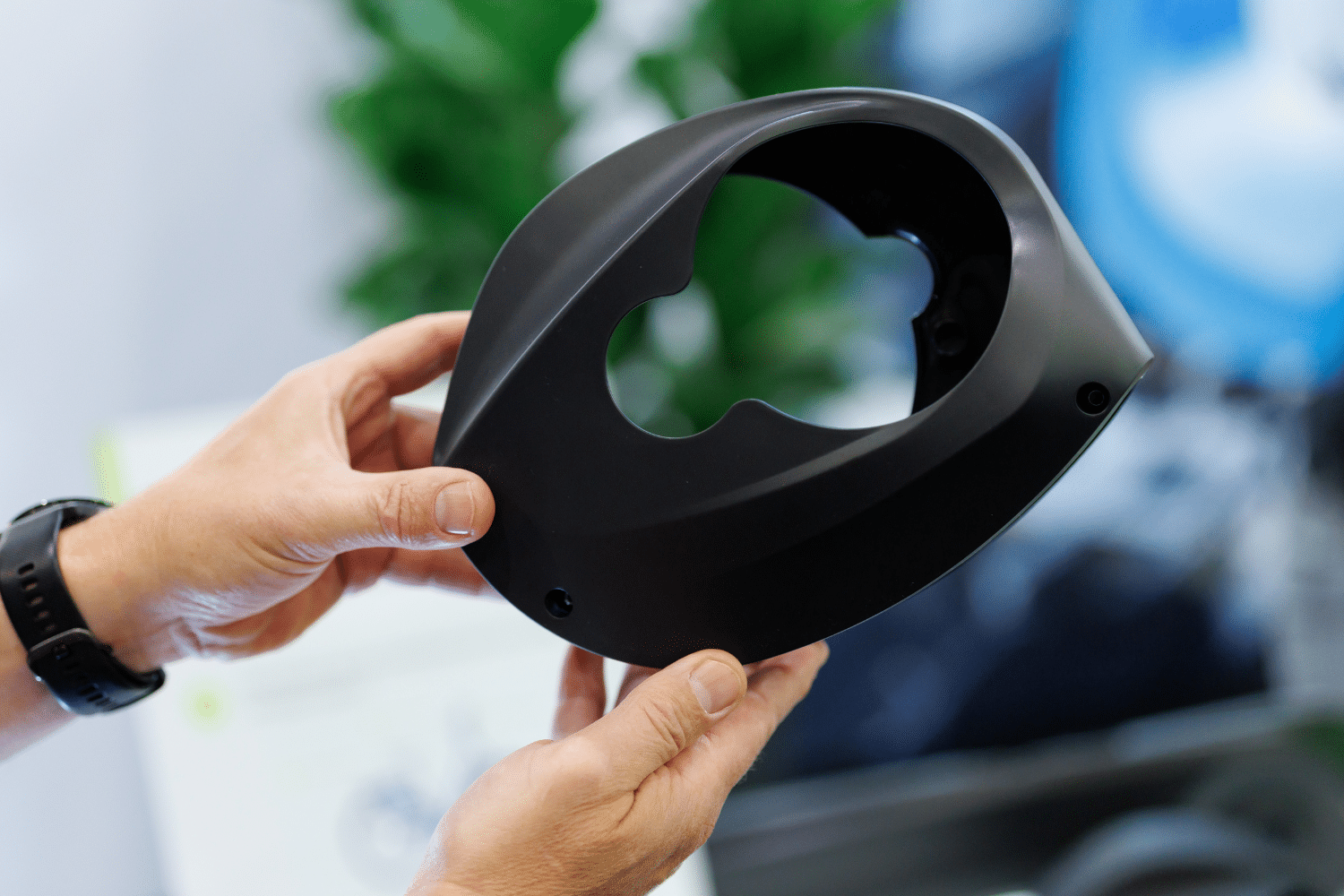
More than just replacing parts
Replacing virgin plastics with recycled materials seems like a logical step, but in practice it presents several challenges—not only from a technical standpoint, but also in terms of collaboration with OEMs, who ultimately decide whether to take this step. It requires confidence in the end product as well as a willingness to reevaluate existing specifications and assumptions.
At the product level, that complexity becomes immediately apparent. Components have varying requirements in terms of strength, appearance, and stress during use. It is precisely this combination that creates complexity: whereas many properties of traditional materials are predictable, recycled materials require a different approach in which variation and uncertainty play a greater role.
From a material issue to a design issue
While the use of new plastics often begins with the material itself, this project demonstrates that circular production requires a broader approach. Material selection, design, and process settings are inextricably linked and must be considered together. In this context, not only the technical suitability of materials plays a role, but also their availability and continuity.
“It turned out that very little recycled material was available, and what is available comes from waste CDs, DVDs, and car headlights, and its future availability is questionable.”
Cindy Bauhuis – Product design manager at Timmerije
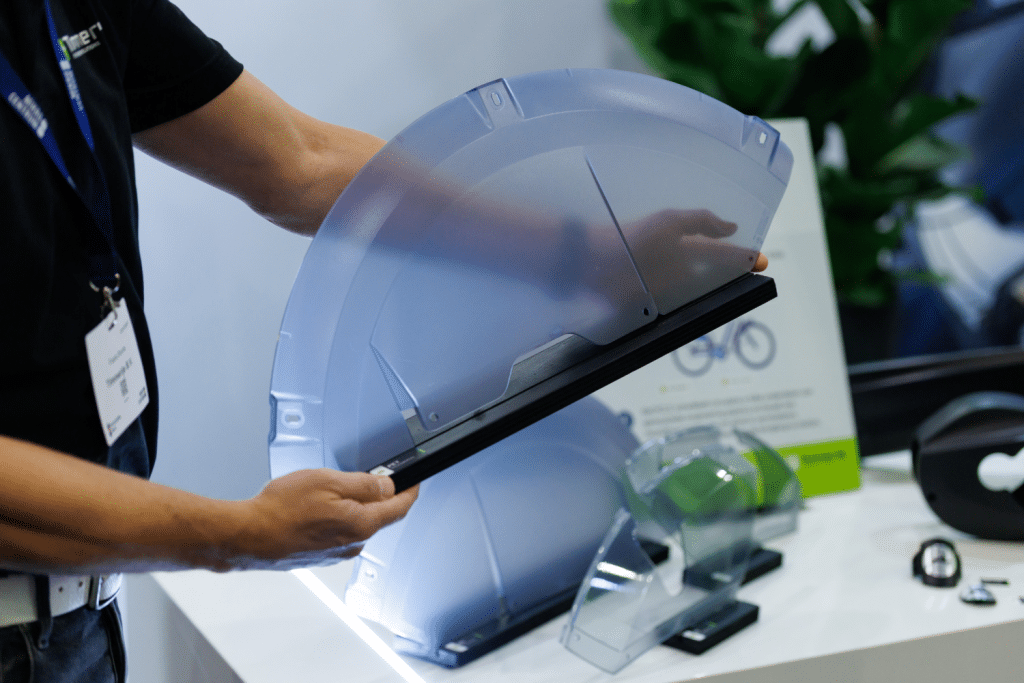
Validation, testing, and redesign
To arrive at a workable solution, the project team deliberately opted for a structured and well-founded approach. This involved examining not only material properties but also the entire process, from design to production. Materials and products were extensively tested to gain insight into their performance over their entire lifespan. By simulating aging and repeatedly processing materials, a better understanding of how recycled material behaves in practice is gained.
Reverse engineering based on quality requirements
The principle of “critical to quality” was central to the project. When using recycled material, material properties change, making it necessary to reassess which product characteristics are truly decisive for the final result.
“When using recycled material, you compromise on certain properties compared to virgin material. That’s why we consulted with Gazelle to determine which properties are critical to quality and where they can push the boundaries a bit more on certain specifications to give us a little more flexibility.”
Hans Kolnaar – Managing director of Timmerije
Based on these priorities, the desired product performance has been translated into specific requirements for the material. This shifts the starting point from material to functionality: design, material selection, and process are tailored to what the product actually needs to be capable of. This also means that, in practice, simply replacing existing plastics is rarely sufficient. Differences in the processability and behavior of recycled materials require adjustments to both product design and the production process. It is precisely this integrated approach that makes it possible to arrive at a stable and reproducible solution.
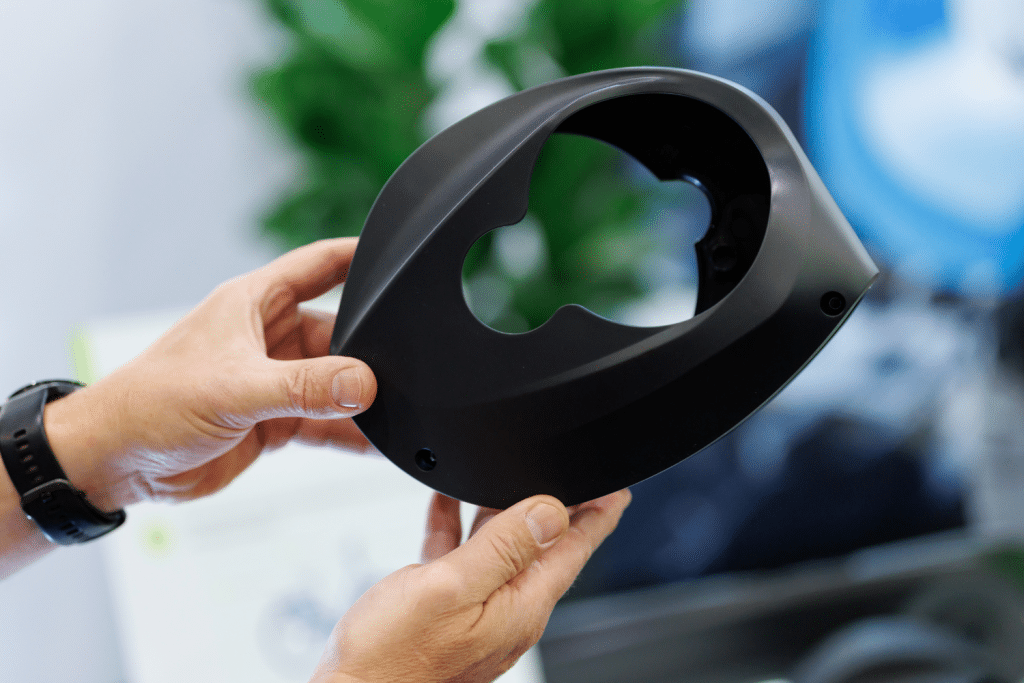
Less complexity, more control
One of the project’s key findings is that simplification leads to greater control. By critically examining the application and function of components, material usage could be reduced and better aligned with the product’s requirements. This approach not only provides greater control in production and procurement but also contributes to the circularity of products at the end of their lifecycle. Less variation in materials makes reuse and recycling more manageable.
To make this step possible, investments were made in real-world validation and extensive materials research. Using prototype molds and additional testing facilities, material choices and design adjustments could be evaluated and optimized under realistic conditions. At the same time, materials and products were extensively tested—including for aging, stability, and reusability—and compared with traditional plastics. This provided early insight into processability, product quality, and any deviations. These issues could then be addressed in a targeted manner before further application took place.
Results in practice
The results of the ReCYCLE project show that circular manufacturing is feasible, provided it is approached holistically. It requires an understanding of the entire supply chain and a willingness to move away from existing practices. Changes in materials have a direct impact on product properties, mold design, and process settings. Only by taking these interdependencies into account can a robust and future-proof solution be created. An initial life cycle analysis shows that the choice of materials, in particular, has a major impact on total CO2 emissions, with reductions of tens of percent being achievable.
Application in new projects
The knowledge gained is now being applied in new projects and applications. As such, the ReCYCLE project is not an endpoint, but rather a starting point for further application in new projects, both within existing markets and in other sectors. For Timmerije, this project confirms that circular production is only successful when collaboration, technical expertise, and manufacturability come together in practice in new projects.