
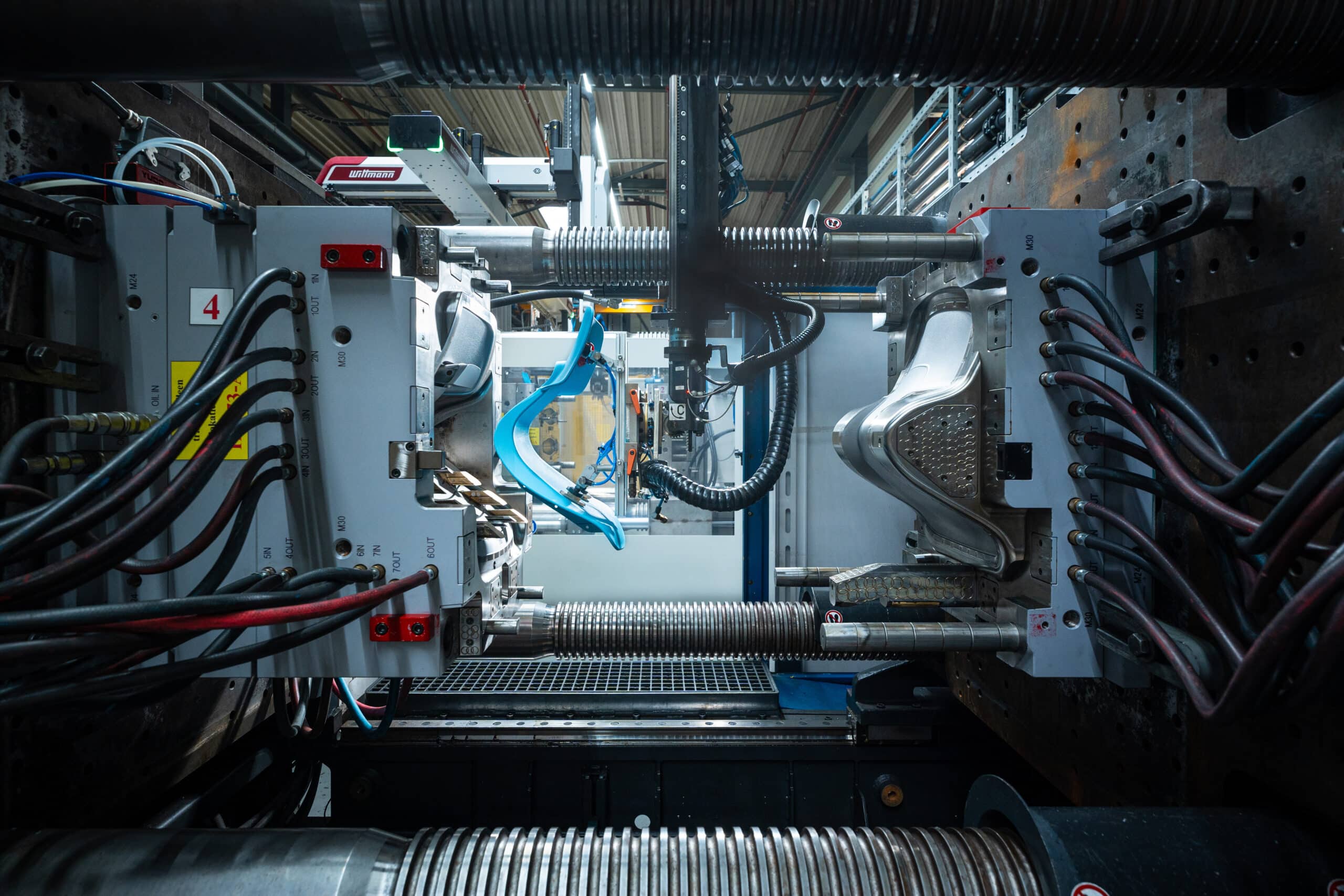
Circulair injection molding
Circular injection molding starts with making the right choices—not just during production, but right from the very first phase of product development. By aligning design, material selection, and production from the very beginning, we develop technical plastic products that contribute to a more efficient use of raw materials and are suitable for reliable mass production. This results in a plastic product in which quality, functionality, manufacturability, and circularity are balanced from the very first design phase.

The process behind circular injection molding
A circular plastic product doesn’t just happen on its own. It is the result of a meticulous development and production process. From the initial product analysis to reliable mass production: every step influences quality, manufacturability, and circularity. By linking these steps together from the very beginning, we develop plastic products that meet both the technical requirements of the application and our customers’ circular ambitions.
01
Analysis
The foundation for a circular plastic product begins with a clear understanding of its application and product requirements.
02
Choice of materials
The right choice of materials determines the balance between performance, service life, and circularity.
03
Engineering
Smart design choices result in an efficient, manufacturable, and future-proof plastic product.
04
Optimalisation
Mold development and process optimization form the foundation for a stable and reliable production process.
05
Mass production
A controlled injection molding process ensures consistent quality and efficient production at scale.
Circular injection molding starts with the right choices
A circular plastic product is not created during production, but rather in the very first phase of the development process. It is precisely at this stage that decisions are made that determine a product’s performance, lifespan, and future circularity. That is why circular injection molding begins with a thorough analysis of the application, the functional requirements, and the project’s objectives. By clearly defining these starting points, we lay a solid foundation for all subsequent steps in the development and production process.
A well-thought-out start to every project
Every application places different demands on a plastic product. Depending on the load, operating environment, tolerances, desired service life, and production volumes, a different material or design choice is required. That is why we assess not only which plastic is technically the best fit, but also which choices contribute to an efficient production process and a future-proof end product. This results in a design in which performance, material usage, manufacturability, and economic feasibility are balanced from the very beginning.
A well-considered choice of material forms the basis for circular injection molding. A plastic’s properties determine not only the performance of the end product but also the potential for efficient material use, reuse, and a stable injection molding process. Based on the functional requirements and the application, we advise on the most suitable material solution, carefully balancing technical performance, quality, processability, and circularity.
There is no one-size-fits-all approach for OEMs. Each application requires its own balance between functionality, material selection, manufacturability, and cost efficiency. By making these choices early in the development process, we prevent unnecessary modifications at a later stage and lay a solid foundation for engineering, process optimization, and eventual mass production.
Engineering makes the difference
In circular injection molding, the most important decisions are made before the first mold is produced. During the engineering phase, design choices determine how a plastic product behaves during injection molding and how efficiently it can ultimately be produced. Factors such as wall thicknesses, product geometry, and material distribution directly influence cycle time, material consumption, dimensional stability, and the quality of the final product. By optimizing these aspects early in the development process, a design is created that not only meets technical requirements but is also suitable for an efficient and reproducible injection molding process.
Engineering for an efficient injection molding process
During the engineering phase, we evaluate each design for manufacturability and producibility. In doing so, we continually seek the optimal balance between functionality, material usage, and process efficiency. Where possible, we reduce material consumption without compromising the performance or reliability of the plastic product.
We also take into account design principles such as Design for Recycling, so that materials can be more easily reused or recycled at the end of their life cycle. To substantiate design choices, we use Moldflow analyses where relevant. This gives us insight—even before production begins—into factors such as filling behavior, potential weld lines, and warpage. This allows us to implement optimizations early on, resulting in a design that is optimally suited to a stable and reliable injection molding process.
Process control as the key to circular injection molding
A good design lays the foundation, but it is only during production that we see whether circular design choices hold up in practice. That is why we pay close attention to the transition from engineering to mass production. By carefully aligning the design, mold, and process, we create a stable production process in which quality, efficiency, and material usage are in balance.
It is precisely during this phase that design choices are translated into a reproducible production process. A carefully optimized injection molding process not only contributes to consistent product quality but also prevents unnecessary material waste and process deviations. In this way, we ensure that the circular principles established during the development phase are maintained throughout the final mass production.
A stable production process without unnecessary waste
A stable injection molding process directly contributes to both the quality and circularity of a plastic product. By precisely adjusting and continuously monitoring process settings, we minimize material loss, prevent unnecessary scrap, and ensure consistent product quality. This results in an efficient production process in which raw materials are used optimally.
Reproducibility plays an important role in this process. A controlled production process ensures that plastic products continue to meet the same quality requirements and specifications, even in large production runs. In this way, the decisions made during the analysis, material selection, and engineering phases are translated into reliable mass production.
Working together on circular plastic products
Circular injection molding is the result of a carefully coordinated development and production process. When product analysis, material selection, engineering, and mass production are seamlessly integrated, the resulting plastic products not only meet the technical requirements of the application but also contribute to a more efficient use of raw materials and a longer service life.
That is why, at Timmerije, we don’t focus on individual process steps, but rather on the entire process. By carefully coordinating each phase, we can balance technical performance, material usage, manufacturability, and quality. This results in plastic products that are not only reliably manufactured but are also designed for a sustainable and circular future.
The power of a comprehensive approach
Developing a circular plastic product requires more than just knowledge of materials or the injection molding process alone. It requires a partner who can integrate engineering, tooling development, and mass production, and who can justify decisions throughout the entire process. It is precisely this integrated approach that enables us to translate circular ambitions into technically reliable and economically viable plastic solutions.