
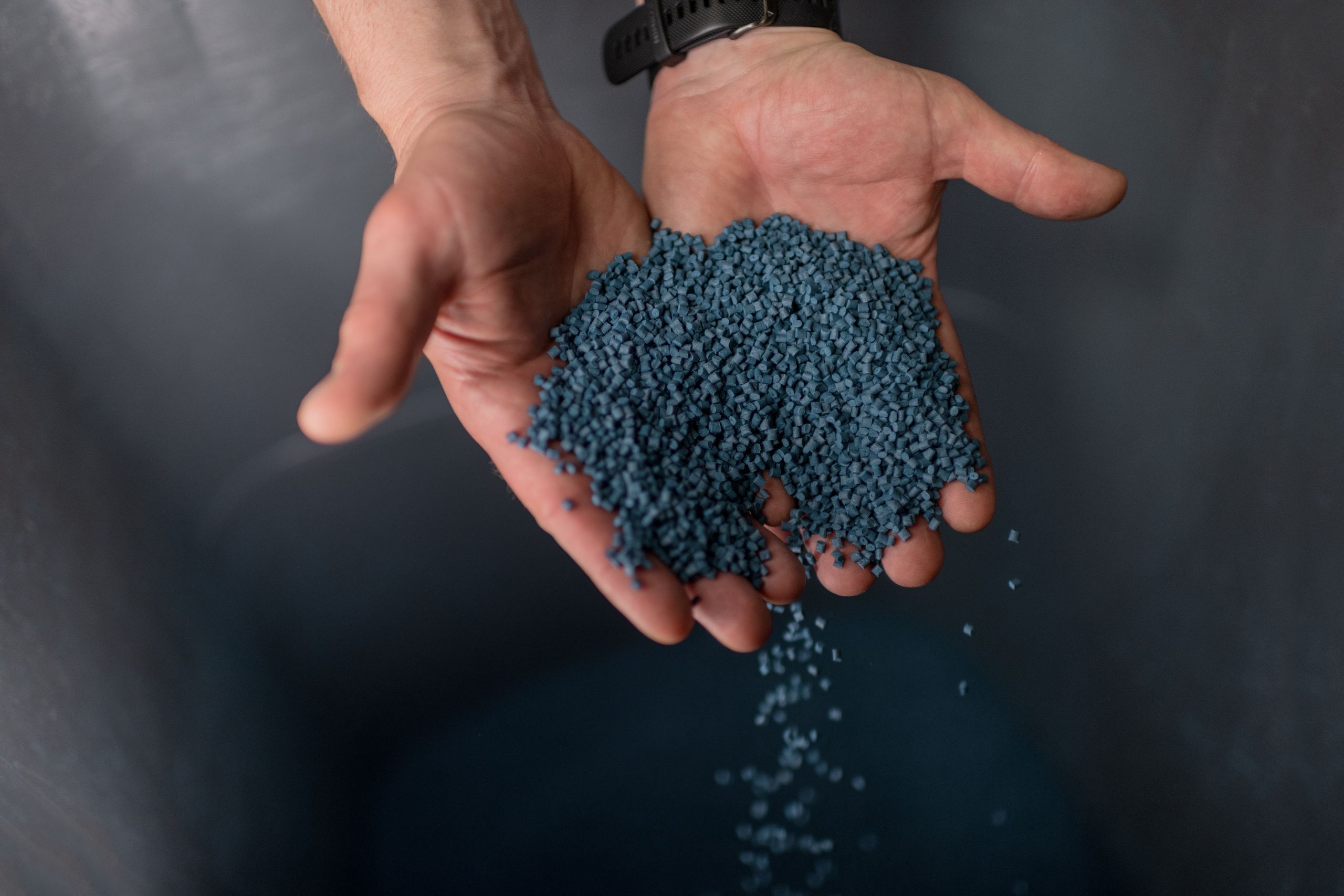
Choosing materials for plastic injection molding
Choosing the right plastic has a major impact on the performance, service life, and manufacturability of an injection-molded product. A material that is well-suited to the application helps prevent issues with dimensional stability, wear, shrinkage, or product quality during mass production.
This page explains what to consider when selecting materials for plastic injection molding and how design, product function, cost, and sustainability collectively determine which plastic is most suitable.

Which plastic is suitable for injection molding?
Not every plastic is suitable for the same application or the same injection-molded product. The right choice depends on the part’s function, the stresses it will endure during use, the desired service life, the environment in which the product will be used, and the requirements for mass production. That is why, in plastic injection molding, material selection does not start with the material’s name, but with what the plastic part needs to be capable of.
In plastic injection molding, the choice of material also affects the manufacturability of the design. Each material behaves differently during filling, cooling, and shrinkage in the mold. As a result, material selection, product design, wall thickness, tolerances, and cost are closely interrelated. A material that appears technically suitable must therefore also be compatible with the design and the production process.
The choice of material starts with function and application
The function of the plastic part determines which material properties are important. Does the part need to be impact-resistant, rigid, flexible, wear-resistant, heat-resistant, or chemically resistant? Requirements regarding appearance, dimensional stability, assembly, and frequency of use also play a role. For technical plastic parts, it is therefore important to translate the application into specific material requirements at an early stage. Combined with sound design guidelines for plastic injection molding, this results in a design that better aligns with material behavior, mold construction, and reproducible production.
Technical requirements determine the appropriate plastic
Technical requirements such as strength, stiffness, temperature behavior, chemical resistance, shrinkage, and wear determine which plastic is suitable for injection molding. A housing, hinge, seal, or load-bearing component each requires different material properties.
Production volume is also a factor. For larger production runs, processability, cycle time, and material cost become more important in determining the final cost. Choosing the right material therefore helps not only to ensure product quality but also to keep the costs of plasticsinjection molding under control.
Key material properties of plastic parts
When selecting materials for plastic injection molding, it is important to consider not only the material name, but especially the properties required for the plastic part. These include strength, stiffness, impact resistance, temperature behavior, chemical resistance, wear resistance, and dimensional stability. These properties determine how the part performs during use and how well the material can be processed in the injection molding process.
Just because a material is strong doesn’t automatically mean it’s suitable for every application. Some plastics are particularly appealing because of their flexibility, light weight, or chemical resistance. Other materials are chosen for their dimensional stability, wear resistance, or ability to withstand higher temperatures. The right choice therefore always depends on the product’s function, load, environment, and desired service life.
Strength, stiffness, and impact resistance
Strength, stiffness, and impact resistance determine how a plastic part responds to stress, assembly, and daily use. For example, an enclosure often requires impact resistance and dimensional stability, while a technical moving part is more likely to require wear resistance or low friction. Materials such as ABS are often chosen for their good balance of impact resistance, stiffness, and processability, while POM is known for its dimensional stability and wear resistance.
Design also plays an important role in this regard. Wall thickness, ribs, radii, and product geometry all contribute to determining how strong and stable the part will ultimately be. For this reason, material properties must always be evaluated in conjunction with the design guidelines for plastic injection molding and the loads the product will be subjected to in actual use.
Temperature, chemical resistance, and wear
The operating environment often determines which plastic is suitable. A component exposed to heat, cleaning agents, moisture, friction, or chemicals requires different material properties than a product used only indoors and under low stress. PP, for example, is known for its good chemical resistance and low weight, while engineering plastics or high-performance plastics may be necessary at higher temperatures or under more demanding mechanical conditions.
Temperature behavior is particularly important for dimensional stability, shrinkage, and service life. Plastics expand, shrink, and deform differently when exposed to heat. Therefore, the choice of material must be tailored to the application, the desired tolerances, and the expected conditions during use. For complex parts, a Moldflow analysis for injection-molded products can help to better estimate material behavior, shrinkage, and deformation in advance.
In practice, ABS is often chosen for its good impact resistance, PP for its chemical resistance and low weight, while high-performance plastics are particularly suitable for applications involving higher temperatures or more demanding mechanical requirements.
Commonly used plastics in injection molding
In plastic injection molding, both standard plastics and engineering plastics are used. The choice depends on the part’s function, the desired properties, and the requirements for processing, dimensional stability, and mass production. Commonly used materials include ABS, PP, PA, POM, PC, and TPE. These plastics vary significantly in impact resistance, stiffness, chemical resistance, wear resistance, temperature behavior, and shrinkage.
There is therefore no “best plastic” for every injection-molded product. A material suitable for a housing is not automatically suitable for a moving part, a seal, or a dimensionally critical component. That is why material selection must always be based on product function, load, design, and manufacturing process. For example, ABS is widely used for impact-resistant and dimensionally stable parts, while PP is often a good choice due to its low weight and chemical resistance.
Comparing ABS, PP, PA, POM, and PC
ABS is often chosen for plastic parts where impact resistance, dimensional stability, and a good surface finish are important. The material is widely used for housings, technical components, and products where appearance is also a factor. PP is lightweight, relatively tough, and highly resistant to many chemical influences, making it suitable for functional parts, packaging, and applications where weight and chemical resistance are important.
PA, also known as nylon, is often used for technical parts that need to be wear-resistant, strong, and capable of withstanding mechanical stress. POM is a good choice for parts where dimensional stability, low friction, and wear resistance are important, such as gears, sliding elements, or precision technical components. PC, on the other hand, is often chosen when impact resistance, transparency, or higher temperature resistance is desired. The right choice always depends on the requirements for function, load, tolerances, and service life of the plastic part.
TPE and 2K applications
In addition to rigid plastics, flexible materials such as TPE are also used in injection molding. TPE combines rubber-like properties with the processability of thermoplastics. This makes it suitable for applications such as handles, seals, anti-slip parts, cushioning, or flexible contact surfaces.
TPE is also frequently used in two-component injection molding, where two materials or colors are combined into a single product. Examples include a rigid plastic base with a soft grip, seal, or functional edge. In such applications, material adhesion, shrinkage behavior, hardness, and processing temperature must be carefully coordinated. This results in a plastic injection-molded product in which material selection, design, and function come together seamlessly.
Material selection, costs, and sustainability
The choice of material in plastic injection molding directly affects the cost, processability, and durability of a plastic part. Materials differ not only in price per kilogram or raw material cost, but also in cycle time, shrinkage behavior, dimensional stability, risk of scrap, and required process settings. A cheaper material is therefore not always the most cost-effective choice if it leads to longer production times, more scrap, or insufficient product quality.
Sustainability is also playing an increasingly important role in the selection of plastics. Depending on the application, factors such as material reduction, reusability, recyclability, or the use of recycled plastics may be considered. However, the technical function remains the primary consideration: the material must meet the requirements for strength, durability, safety, and mass production.
Impact of material on cost and cycle time
The cost of a plastic part is partly determined by material consumption and processing time. Material weight, wall thickness, flow properties, and cooling time all influence the cost of plastic injection molding. A material that can be processed quickly and consistently can help reduce the cost per part for larger production runs.
That is why material selection must always be evaluated in conjunction with design and production volume. An engineering plastic may be more expensive to purchase, but it may still be the best choice if it results in a component that lasts longer, performs better, or requires less post-processing. When in doubt, an early evaluation of the design, material, and process helps strike the right balance between quality and cost.
Recycled plastics and circular solutions
In plastic injection molding, recycled plastics can be a viable option when the application and quality requirements allow for it. Recycled materials can help reduce material usage and lower the environmental impact, but they do require a careful assessment of properties such as strength, color consistency, processability, shrinkage, and dimensional stability.
Not every product is automatically suitable for recycled materials. When it comes to technical plastic parts, factors such as function, load capacity, service life, and quality requirements must always be taken into account. By incorporating sustainability into the design phase, the choice of materials, wall thickness, product design, and production process can be better aligned. This results in a plastic part that is not only manufacturable but also fits within broader circular economy goals.
Frequently Asked Questions
About material selection in plastic injection molding
Which plastic is suitable for injection molding?
The most suitable plastic depends on the part’s function, load, operating environment, and desired service life. Materials used in plastic injection molding include ABS, PP, PA, POM, PC, and TPE. Each material has different properties in terms of strength, stiffness, impact resistance, chemical resistance, temperature behavior, and shrinkage.
When should you choose ABS for plastic injection molding?
ABS is often chosen for plastic parts where impact resistance, dimensional stability, and a smooth surface finish are important. The material is widely used for enclosures, technical components, and parts where both functionality and appearance are important.
When is PP a suitable plastic material?
PP is suitable for applications where low weight, toughness, and chemical resistance are important. The material is often used for functional plastic parts that must be resistant to moisture or certain chemical influences. Its exact suitability always depends on the application and the product requirements.
What is the difference between PA and POM?
PA, also known as nylon, is often used for strong components that are subject to mechanical stress. POM is particularly suitable when dimensional stability, low friction, and wear resistance are important. Both materials are used in engineering plastic components, but the best choice depends on the load, tolerances, wear, and operating environment.
Can recycled plastics be used in injection molding?
Yes, recycled plastics can be used in injection molding when the application and quality requirements allow it. Recycled material must be thoroughly evaluated for strength, processability, color consistency, shrinkage, dimensional stability, and service life. For technical plastic parts, the product’s function remains the primary consideration.
How does the choice of material affect the cost of plastic injection molding?
The choice of material affects raw material costs, product weight, cycle time, shrinkage behavior, scrap rates, and post-processing. A cheaper material is not always the most cost-effective choice if it results in longer production times or lower product quality. Therefore, the choice of material must always be tailored to the design, production volume, and desired performance.
Want to learn more about plastic injection molding?