
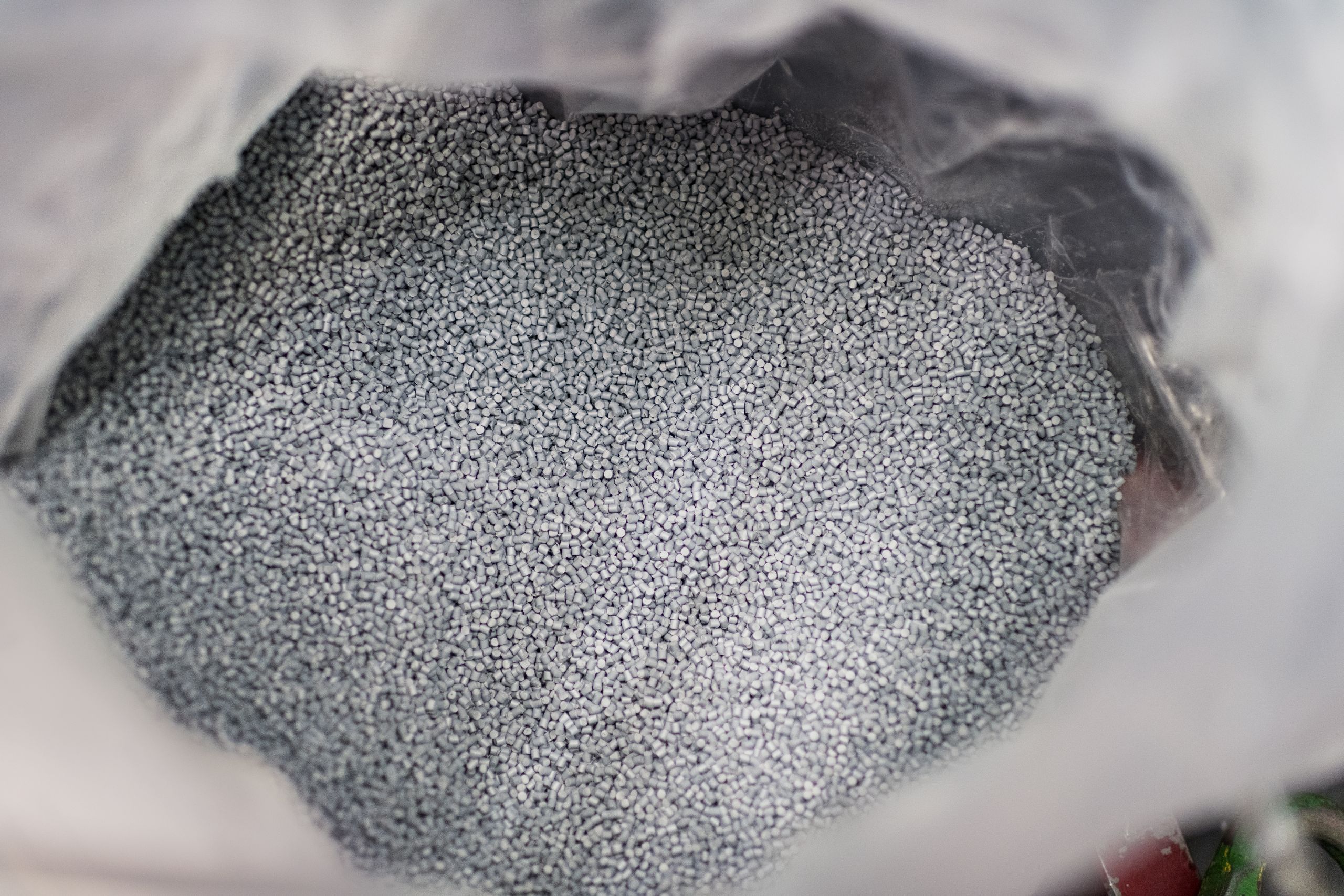
Types of plastic for injection molding
Plastics vary greatly in terms of properties, processability, and applications. Not every plastic is suitable for the same product or production process. In plastic injection molding, factors such as strength, flexibility, temperature behavior, chemical resistance, shrinkage, and recyclability play an important role.
On this page, you can learn how different types of plastics differ from one another and which properties determine whether a material is suitable for plastic injection molding.

What types of plastics are there?
Plastics can be divided into three main groups: thermoplastics, thermosets, and elastomers. These types of plastics differ in their properties, processability, and applications. For plastic injection molding, it is particularly important how a material reacts to heat, pressure, cooling, and stress during use.
Thermoplastics soften when heated and can then be reshaped. This makes them well-suited for injection molding and widely used in the manufacture of engineering plastic parts. Thermosets, on the other hand, remain hard and retain their shape after curing, even when heated. Elastomers have rubber-like properties and are used when flexibility, resilience, or sealing are important.
Thermoplastics, thermosets, and elastomers
Thermoplastics are plastics that become malleable when heated and harden again after cooling. This process can be repeated multiple times, making thermoplastics suitable for mass production, reprocessing, and recycling. Examples include PP, PE, ABS, PA, POM, and PC.
Thermosets are plastics that do not remelt or deform after curing. They are often dimensionally stable and heat-resistant, but less suitable for reprocessing. Elastomers are elastic plastics with rubber-like properties. Thermoplastic elastomers, such as TPE, can be processed via injection molding and are often used for seals, grip surfaces, or flexible product components.
Why the type of plastic determines its processing and application
The type of plastic determines whether a material is suitable for a particular application and whether it can be processed effectively via plastic injection molding. A material must flow smoothly into the mold, cool in a controlled manner, and retain sufficient dimensional stability after production. Properties such as strength, stiffness, impact resistance, chemical resistance, shrinkage behavior, and wear resistance also play an important role.
That is why the choice of material in plastic injection molding always starts with the product’s function. A high-load engineering plastic part requires different properties than a flexible sealing component or a lightweight housing. By selecting the right type of plastic, you can create a product that is better suited to the application, manufacturability, and desired production volume.
Thermoplastics and their role in plastic injection molding
Thermoplastics play a key role in plastic injection molding because they soften when heated and harden again after cooling. This allows them to be molded into precise plastic parts. As a result, thermoplastics are well-suited for mass production, complex shapes, and products where dimensional stability, functionality, and reproducibility are critical.
In addition, many thermoplastics can be recycled, provided the material and application allow for it. This makes this group of plastics an attractive option for products where material usage, recyclability, and sustainability are just as important as technical performance. The final choice always depends on function, design, load, desired service life, and production volume.
Why thermoplastics are suitable for injection molding
Thermoplastics are suitable for injection molding because they can flow when heated and are injected into a mold under pressure. Once cooled, the part retains its shape. This process makes it possible to produce plastic parts efficiently and with consistent results.
Processing characteristics vary by thermoplastic. Some materials flow more easily, while others require higher processing temperatures or longer cooling times. That is why it is important to select the material based on the design, the desired tolerances, and the costs of plastic injection molding.
Amorphous and semi-crystalline thermoplastics
Within the category of thermoplastics, a distinction is often made between amorphous and semi-crystalline materials. Amorphous thermoplastics have a more disordered molecular structure and are often chosen when dimensional stability, transparency, or good surface quality are important. Examples include ABS, PC, PMMA, and PS.
Semi-crystalline thermoplastics have partially ordered molecular structures. These materials are often strong, wear-resistant, and chemically resistant, but may also exhibit greater shrinkage during cooling. Examples include PP, PE, PA, POM, and PBT. When choosing between amorphous and semi-crystalline plastics, product function, tolerances, shrinkage behavior, and material selection play an important role.
Thermoplastic pyramid
The thermoplastic pyramid shows that thermoplastics can be classified based on performance, technical properties, and area of application. At the bottom are the commodity plastics, such as PE, PP, and PS. These plastics are versatile, relatively cost-effective, and suitable for many standard plastic parts.
Above these are the engineering plastics, such as ABS, PA, POM, PC, and PBT. These materials are more commonly used in technical plastic components that require higher standards for strength, dimensional stability, wear resistance, temperature performance, or chemical resistance. At the top of the pyramid are high-performance plastics, such as PPS, PEI, and PEEK. These plastics are suitable for applications involving high temperatures, heavier mechanical loads, or more aggressive operating conditions.
In the context of plastic injection molding, this classification helps to better align material selection with function, load, quality requirements, and cost. The higher a material is positioned in the pyramid, the more specialized its performance characteristics tend to be. At the same time, material costs, processing requirements, and technical considerations often increase as well.
Commodity plastics for a wide range of applications
Commodity plastics are widely used when cost-effectiveness, light weight, and widespread availability are key considerations. Materials such as PE, PP, and PS are suitable for many general-purpose applications, but have limitations when exposed to high temperatures, heavy mechanical stress, or very tight tolerances.
For simple or less heavily loaded plastic parts, commodity plastics may be a suitable choice. However, it remains important to carefully assess material behavior, shrinkage, wall thickness, and product function. This allows you to determine whether the material is suitable for the design and for stable mass production.
Engineering and high-performance plastics for technical components
Engineering plastics and high-performance plastics are used when a plastic part must meet higher technical requirements. These include improved dimensional stability, wear resistance, strength, temperature resistance, or chemical resistance. These materials are particularly relevant for technical plastic parts where function, service life, and reliability are more important than simply the lowest material cost.
The choice of an engineering plastic must always be tailored to the design, application, and manufacturing process. A high-performance material is not automatically the best choice if the product does not require those properties. Comparing plastic types based on function, processability, and cost provides a better basis for material selection in plastic injection molding.
Which type of plastic is right for your application?
Choosing the right plastic starts with the product’s function. A part that needs to retain its shape requires different properties than a flexible sealing component, an impact-resistant housing, or a wear-resistant engineering component. That is why the choice of plastic must always be tailored to the load, operating environment, service life, tolerances, and desired appearance.
The production process also plays a role here. In plastic injection molding, the material, design, and mold must be well-matched. Properties such as flow, shrinkage, cooling time, and dimensional stability determine whether a material is suitable for stable mass production. A material may be technically strong, but it may still be less suitable if it does not align with the design or the desired cost.
Properties such as strength, temperature resistance, and chemical resistance
Key properties of plastics include strength, stiffness, impact resistance, temperature resistance, chemical resistance, wear resistance, and flexibility. For products exposed to heat, moisture, cleaning agents, or mechanical stress, it is important to evaluate these properties early on.
For example, a housing often requires impact resistance and a clean finish, while a moving part must be wear-resistant and dimensionally stable. For parts that come into contact with chemicals or fluctuating temperatures, chemical resistance and temperature behavior are key factors in determining the product’s service life.
Selecting materials to suit the design and mass production
A good choice of material takes into account both the application and the manufacturability of the product. Wall thickness, ribs, tolerances, gate locations, and the risk of warping all help determine which material is suitable. That is why it is wise not to consider material selection and design guidelines in isolation from one another.
By coordinating the choice of plastic, product design, and production volume at an early stage, we can create a plastic part that is easier to manufacture. This helps to minimize production risks, ensure quality, and keep costs under control.
Frequently Asked Questions
about the different types of plastic
What are the main types of plastic?
The main types of plastics are thermoplastics, thermosets, and elastomers. Thermoplastics soften when heated and can be reshaped. Thermosets retain their shape after curing and cannot be remelted. Elastomers have rubber-like properties and are used when flexibility, resilience, or sealing are important.
Which types of plastic are suitable for injection molding?
Thermoplastics are the primary materials used in plastic injection molding. These materials can flow when heated, be shaped in a mold, and retain their shape after cooling. Commonly used thermoplastics include PP, PE, ABS, PA, POM, PC, and TPE.
What is the difference between thermoplastics and thermosets?
The main difference lies in their behavior when heated. Thermoplastics soften when heated and can be reshaped. Thermosets cure permanently and retain their shape thereafter, even when heated. As a result, thermoplastics are better suited for injection molding and reprocessing.
What are engineering plastics?
Engineering plastics are technical plastics with superior mechanical, thermal, or chemical properties compared to standard plastics. They are used in plastic components that require higher levels of strength, dimensional stability, wear resistance, temperature resistance, or service life. Examples include PA, POM, PC, and PBT.
What are commodity plastics?
Commodity plastics are commonly used standard plastics such as PE, PP, and PS. They are widely available, relatively cost-effective, and suitable for many general-purpose applications. In cases involving heavy mechanical stress, high temperatures, or tight tolerances, engineering plastics or high-performance plastics are often more suitable.
Are thermoplastics recyclable?
Many thermoplastics can, in principle, be reprocessed because they soften when heated and can be reshaped. Whether recycling is feasible in practice depends on the type of plastic, its application, contamination, color, additives, and the quality requirements of the end product. For technical plastic components, recyclability must always be weighed against functionality, safety, and product quality.
Want to learn more about plastic injection molding?