
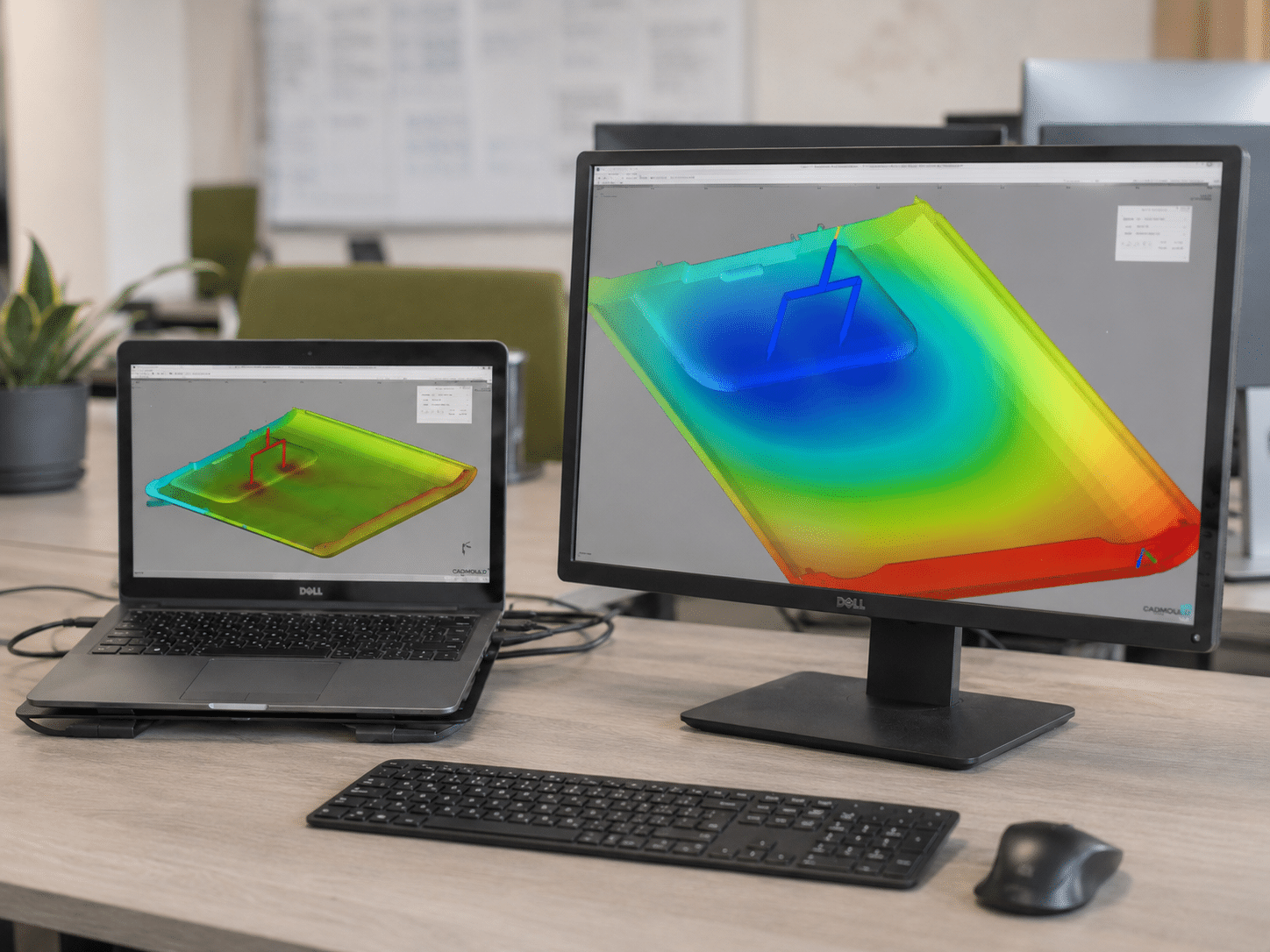
Why perform a Moldflow-analysis?
A good design does not guarantee complete certainty about how a plastic part will behave during injection molding. Filling behavior, pressure buildup, shrinkage, weld lines, air pockets, and warpage can only be properly assessed when the design, material, and mold concept are considered together.
This page explains how a Moldflow analysis helps to simulate plastic injection-molded products in advance, mitigate manufacturing risks, and better align design choices with manufacturability and mass production.

What is a Moldflow analysis?
A Moldflow analysis is a simulation of the injection molding process. It provides insight in advance into how molten plastic moves through the mold, how it fills the part, and where potential risks may arise. These include issues such as filling behavior, pressure buildup, weld lines, air entrapment, shrinkage, or warpage.
In plastic injection molding, a Moldflow analysis helps to better align the design, material selection, and mold concept. This allows production risks to be assessed even before the mold is built. As a result, it is possible to make more targeted adjustments to the design and improve the manufacturability of the plastic part.
Simulation of the injection molding process
During a Moldflow analysis, the injection molding process is digitally simulated. The simulation shows how the plastic fills the mold, how quickly different zones are reached, and where extra attention may be needed. This provides valuable information about the position of gate locations, the flow path, and the distribution of material within the product. This simulation can be particularly helpful in reducing uncertainties for technical plastic parts with complex geometries, visible surfaces, or critical tolerances. The analysis therefore aligns well with the design guidelines for plastic injection molding.
Understanding filling behavior, pressure, and cooling
A Moldflow analysis provides insight into factors such as filling behavior, pressure distribution, cooling, shrinkage, and potential warpage. This information helps determine whether the design is suitable for stable mass production. It also allows for an assessment of whether wall thicknesses, material selection, or gate locations need to be adjusted.
If the analysis is conducted early in the process, adjustments can be made before investing in mold construction. This helps to mitigate risks and keep the costs of plastic injection molding more manageable.
What issues does a Moldflow analysis help identify?
A Moldflow analysis in plastic injection molding identifies potential production risks before the mold is manufactured. Among other things, the simulation shows how the plastic flows through the mold, where the material converges, and which areas are prone to shrinkage, air pockets, or warping.
This is particularly valuable for technical plastic parts with complex shapes, visible surfaces, tight tolerances, or functional fits. By assessing these risks early on, the design can be adjusted before any modifications to the mold are required. This helps improve manufacturability and makes the transition to mass production more reliable.
Welds, air pockets, and incomplete filling
During injection molding, weld lines can form where two material streams meet. Depending on the part’s position and the stresses it is subjected to, these areas can affect strength, appearance, or functionality. Air pockets can also cause problems, such as visible defects, weak spots, or insufficient filling of certain parts of the product.
A Moldflow analysis can identify these risks in advance. This makes it possible to determine whether gate locations, flow paths, wall thickness, or venting need to be adjusted. This directly contributes to a manufacturable design that meets the specified requirements.
Shrinkage, warping, and distortion
Shrinkage, warping, and deformation are often caused by uneven cooling, variations in wall thickness, material behavior, or stress within the plastic part. These issues can affect dimensional accuracy, assembly, visual quality, and product reliability. A Moldflow analysis helps identify shrinkage behavior and deformation risks early on. Especially when combined with the correct wall thickness and appropriate material selection for plastic injection molding, this results in a design that is better suited for stable production and consistent product quality.
Using Moldflow analysis during the design phase
A Moldflow analysis is most valuable when it is used during the design phase. At that stage, it is still relatively easy to make adjustments to the plastic part. These might include changes to wall thickness, ribs, gate locations, material selection, or product geometry.
By simulating the design early on, you can determine whether the part is suitable for plastic injection molding and stable mass production. This prevents problems from only becoming apparent during trial runs or after the mold has already been made. The analysis therefore helps to better align the design, material, and production process.
Assess sprue points, wall thickness, and material selection
The position of sprue points has a significant impact on filling behavior, the placement of weld lines, pressure buildup, and the visual quality of the product. A Moldflow analysis can be used to assess whether the chosen gate location is appropriate for the part’s shape and function. Wall thickness and material selection are also considered during this phase. A different wall thickness or type of plastic can affect shrinkage, cooling, warpage, and cycle time. By evaluating these choices in advance, a more manufacturable plastic injection-molded product is created.
Optimizing product design prior to mold construction
One of the biggest advantages of Moldflow analysis is that the design can be optimized before the mold is built. This is important because making changes after the mold has been built is often more expensive and time-consuming. By identifying risks of shrinkage, weld lines, air pockets, or warping early on, targeted design adjustments can be made. This aligns directly with the design guidelines and helps minimize unnecessary corrections, delays, and additional costs associated with plastic injection molding.
From simulation to a reliable injection-molded product
A Moldflow analysis is not an end in itself, but a tool for achieving a better and more reliable plastic injection-molded product. The insights gained from the simulation are used to further optimize the design, material selection, gate locations, wall thickness, and mold concept before production begins.
Moldflow thus serves as a vital link between engineering and mass production. By identifying potential risks in advance, it enables a more robust design and allows for a more stable injection molding process. This contributes to consistent quality, fewer corrections, and a more efficient path to production.
Fewer production risks during mass production
In mass production, consistent product quality is essential. Issues such as shrinkage, warping, weld lines, or air pockets can lead to rejects, additional inspections, or adjustments to the production process. A Moldflow analysis allows these risks to be better assessed even before production begins. By optimizing the design and process in advance, the likelihood of unexpected problems during plastic injection molding is reduced. This helps ensure that technical plastic parts are produced in a more stable, predictable, and reproducible manner.
Better justification of the design, mold, and process
The results of a Moldflow analysis provide greater insight into design, mold, and production process decisions. Consider factors such as sprue points, expected pressure buildup, filling behavior, cooling, shrinkage, and potential warpage. This information helps to better substantiate technical decisions before investing in mold construction.
This results in a design that is not only functionally sound but also better suited to manufacturability, product quality, and mass production. Especially for complex or dimensionally critical plastic parts, Moldflow can contribute to a more reliable development process and a stronger end result.
Frequently Asked Questions
about Moldflow analysis in plastic injection molding
What is a Moldflow analysis?
A Moldflow analysis is a digital simulation of the injection molding process. The analysis shows how plastic flows through the mold, how the product fills, and where potential risks may arise. These include weld lines, air pockets, shrinkage, pressure buildup, or warping.
When is a Moldflow analysis useful?
A Moldflow analysis is particularly useful for complex plastic parts, critical tolerances, visible parts, or products at risk of shrinkage, warping, or incomplete filling. The analysis can also be valuable for larger production runs, as it allows for a more accurate assessment of production risks in advance.
What problems can a Moldflow analysis predict?
A Moldflow analysis can provide insight into filling behavior, weld lines, air entrapment, pressure distribution, shrinkage, and potential warpage. This helps identify areas where the design, wall thickness, material selection, or gate location may need to be adjusted.
Does a Moldflow analysis help reduce costs?
Yes, a Moldflow analysis can help reduce costs by identifying risks before the mold is built. Design changes are usually easier and less expensive at that stage than if problems only become apparent during trial runs or mass production.
Is a Moldflow analysis always necessary in plastic injection molding?
Not always. For simple plastic parts with wide tolerances and limited risk, a Moldflow analysis is not always necessary. However, for complex products, technical parts, visible components, or applications where dimensional accuracy is critical, the analysis can add significant value.
What is the difference between Moldflow analysis and trial molding?
A Moldflow analysis digitally simulates the injection molding process before the mold is built. Trial molding takes place later, using the actual mold and the selected material. By simulating the process first, risks can be assessed earlier and the design can be better prepared for production.